How Industrial Ultrafiltration Systems Work: A Complete Guide
Industrial ultrafiltration systems use membrane technology to separate suspended solids, colloids, bacteria, viruses, and larger dissolved or suspended organic molecules from water.
The process uses pressure to push feed water through a membrane containing very small pores while retaining substances that are larger than the membrane's effective separation range.
Ultrafiltration, commonly abbreviated as UF, is used in drinking-water treatment, industrial wastewater treatment, process-water preparation, food processing, pharmaceutical manufacturing, and water reuse applications. It can also be integrated with other treatment technologies such as reverse osmosis, activated carbon, and conventional pretreatment.
Why Industrial Ultrafiltration Systems Matter
Many industrial processes require water with controlled levels of suspended solids and microorganisms. Conventional filtration methods may not provide the separation required for certain applications.
Ultrafiltration provides a membrane-based barrier that can consistently separate many particulate and macromolecular contaminants. Depending on the feed-water characteristics and membrane configuration, UF can be used as a standalone treatment stage or as pretreatment for downstream membrane processes.
Common objectives include:
- Removing suspended solids
- Reducing turbidity
- Separating colloidal particles
- Reducing microorganisms
- Removing larger organic molecules
- Producing consistent feed water for downstream treatment
- Supporting industrial water reuse
How Industrial Ultrafiltration Systems Work
An industrial UF system typically moves feed water through several stages.
1. Feed Water Preparation
Water first passes through pretreatment equipment designed to protect the ultrafiltration membranes.
Pretreatment can include screens, strainers, cartridge filters, chemical conditioning, or other processes depending on the feed-water characteristics.
The purpose is to reduce the concentration of large particles and substances that could interfere with membrane operation.
2. Feed Pumping
A pump moves the prepared water toward the ultrafiltration membrane modules.
The system maintains a pressure difference across the membrane. This pressure drives water through the membrane while larger retained substances remain on the feed side.
3. Membrane Separation
The core of the system is the ultrafiltration membrane.
Water and smaller dissolved substances can pass through the membrane as permeate, while larger particles and retained contaminants remain in the concentrate or retentate stream.
The exact separation behavior depends on membrane characteristics, feed-water chemistry, operating pressure, and the physical properties of the contaminants.
4. Permeate Collection
Water that passes through the membrane is collected as permeate.
Permeate quality depends on the membrane type, feed-water condition, operating parameters, and system configuration.
5. Concentrate Removal
Material retained by the membrane becomes concentrated in the feed or retentate stream.
This stream may be discharged, recirculated, or directed to another treatment stage depending on the overall process design.
6. Membrane Cleaning
Over time, substances can accumulate on or within the membrane structure. This can reduce water flux and increase pressure requirements.
UF systems therefore use cleaning procedures such as backwashing, chemically enhanced backwashing, or periodic clean-in-place processes, depending on the membrane and system design.
Main Types of Ultrafiltration Membrane Systems
Industrial UF systems can use different membrane configurations.
Hollow-Fiber Membranes
Hollow-fiber systems contain many small tubular membrane fibers within a module.
Feed water can flow through or around the fibers depending on the membrane configuration. Hollow-fiber modules provide a large membrane area within a compact arrangement.
Spiral-Wound Membranes
Spiral-wound modules contain membrane sheets and spacers wound around a central collection tube.
They are commonly used in membrane filtration applications where a compact module arrangement is desirable.
Tubular Membranes
Tubular membranes use larger membrane channels that can accommodate feed streams containing higher concentrations of suspended material.
Their larger flow passages can simplify handling of certain difficult feed streams.
Ceramic Ultrafiltration Membranes
Ceramic membranes use inorganic materials rather than polymeric membrane media.
They can provide resistance to certain temperatures, chemicals, and cleaning conditions, depending on the membrane material and system design.
Comparison of Ultrafiltration Membrane Types
| Membrane Type | Basic Configuration | Typical Characteristic |
|---|---|---|
| Hollow fiber | Multiple small fibers | High membrane area in compact modules |
| Spiral wound | Layered membrane sheets | Compact modular arrangement |
| Tubular | Larger membrane channels | Suitable for selected high-solids feeds |
| Ceramic | Inorganic membrane structure | High resistance in selected conditions |
Main Components of Industrial Ultrafiltration Systems
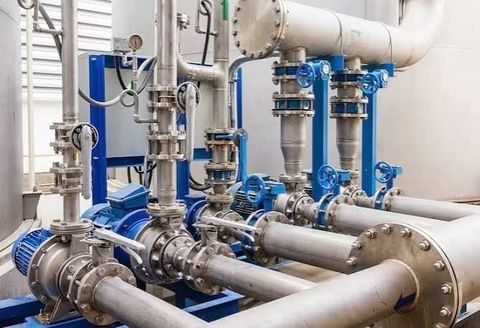
Feed Pump
The feed pump moves water into the membrane system and provides the pressure required for filtration.
Pretreatment Equipment
Pretreatment components remove larger particles or modify feed-water conditions before the water reaches the membranes.
Membrane Modules
Membrane modules contain the actual UF membrane material where separation takes place.
Pressure Sensors
Pressure instruments monitor conditions at different points of the system.
Flow Meters
Flow meters measure feed, permeate, and concentrate flow rates.
Valves
Valves regulate flow paths during normal operation, backwashing, cleaning, and system isolation.
Control System
A control system coordinates pumps, valves, cleaning sequences, alarms, and operating parameters.
Cleaning System
Cleaning equipment supplies water and, where appropriate, cleaning chemicals for membrane maintenance.
Factors Affecting Ultrafiltration Performance
Several factors influence membrane performance.
Feed-Water Quality
High levels of suspended solids, oils, organic matter, or other contaminants can increase membrane fouling.
Transmembrane Pressure
Transmembrane pressure provides the driving force for filtration. Excessive pressure does not necessarily result in proportional increases in permeate flow and may contribute to fouling or membrane stress.
Temperature
Water viscosity changes with temperature, which can influence membrane flux. Temperature limits also depend on the membrane material.
Membrane Condition
Membrane aging, fouling, scaling, and physical damage can affect filtration performance.
Flow Conditions
Crossflow velocity or other hydraulic conditions influence the accumulation of retained material on the membrane surface.
Cleaning Frequency
Appropriate cleaning helps control fouling and maintain permeability. Cleaning frequency depends on feed-water quality and operating conditions.
Automation and Monitoring
Industrial ultrafiltration systems commonly use automated controls to maintain stable operating conditions.
Systems can monitor:
- Feed pressure
- Permeate pressure
- Concentrate pressure
- Permeate flow
- Feed flow
- Transmembrane pressure
- Water temperature
- Turbidity
- Conductivity
- Cleaning cycles
- Membrane permeability
Programmable controllers can automatically operate valves and pumps during filtration, backwashing, chemical cleaning, and flushing sequences.
Data logging can also help operators identify changes in membrane performance over time.
Applications of Industrial Ultrafiltration Systems
Drinking Water Treatment
UF systems can reduce suspended particles and microorganisms from suitable source waters and can be integrated into larger water-treatment processes.
Industrial Wastewater Treatment
UF can separate suspended solids, colloids, and certain larger organic substances from industrial wastewater.
Process Water Treatment
Manufacturing facilities may use UF to produce water with controlled particulate levels for production processes.
Food and Beverage Processing
Membrane filtration can be used in selected food-processing applications to separate proteins, suspended material, and other macromolecular substances.
Pharmaceutical Processing
UF systems can be incorporated into processes requiring controlled separation of macromolecules and particulate material.
Water Reuse
UF can provide a membrane barrier as part of water-recycling systems, including pretreatment before reverse osmosis.
Maintenance Requirements
Membrane maintenance is an important part of UF system operation.
Common maintenance activities include:
- Backwashing
- Chemical cleaning
- Membrane inspection
- Pressure monitoring
- Flow measurement
- Valve inspection
- Pump maintenance
- Instrument calibration
- Filter replacement
Operators should monitor changes in permeate flow and pressure. A gradual decline in normalized permeability can indicate membrane fouling or other operating changes.
Cleaning procedures should use chemicals and concentrations compatible with the specific membrane material.
Safety Considerations
Industrial ultrafiltration systems can involve pressurized water, electrical equipment, pumps, valves, and chemical cleaning agents.
Operators should isolate and depressurize equipment before opening membrane housings or performing maintenance. Appropriate personal protective equipment should be used when handling cleaning chemicals.
Chemical storage, dosing, ventilation, and emergency procedures should follow applicable requirements and the chemical manufacturer's safety information.
FAQs
What is an industrial ultrafiltration system?
An industrial ultrafiltration system uses semipermeable membranes to separate suspended solids, colloids, microorganisms, and larger molecules from water or other compatible process fluids.
What does ultrafiltration remove?
Depending on the membrane and feed-water characteristics, ultrafiltration can remove suspended solids, colloids, bacteria, many viruses, and larger organic molecules. It generally does not remove all dissolved salts and small dissolved molecules.
What is the difference between ultrafiltration and reverse osmosis?
Ultrafiltration uses larger membrane pores and primarily targets suspended particles, colloids, microorganisms, and larger molecules. Reverse osmosis uses a much tighter membrane and is designed to remove a broader range of dissolved substances, including many salts.
Why do ultrafiltration membranes need cleaning?
Particles, organic matter, minerals, and microorganisms can accumulate on or within membranes. Cleaning helps control fouling and restore membrane permeability.
Can ultrafiltration be used before reverse osmosis?
Yes. UF is commonly used as a pretreatment stage for reverse osmosis when the feed-water characteristics and system design are appropriate. It can reduce suspended solids and turbidity entering the RO system.
Conclusion
Industrial ultrafiltration systems use pressure-driven membrane separation to remove suspended solids, colloids, microorganisms, and larger molecular substances from suitable water and process streams. The basic process includes pretreatment, pumping, membrane separation, permeate collection, concentrate management, and membrane cleaning.
Hollow-fiber, spiral-wound, tubular, and ceramic membranes provide different configurations for different operating conditions. System performance depends on feed-water quality, pressure, temperature, flow conditions, membrane condition, and cleaning practices.
With appropriate pretreatment, monitoring, and maintenance, ultrafiltration can function as an important treatment stage in industrial water processing, wastewater treatment, process-water preparation, and water-reuse systems.

Related Post...