Concrete Finishing Equipment: An Overview of Modern Finishing Methods
Concrete finishing equipment includes machines and tools used to level, smooth, texture, grind, and polish concrete surfaces after placement.
Concrete finishing machines range from hand-guided equipment to large ride-on systems designed for extensive floors. Their development has followed changes in construction methods, slab sizes, surface requirements, and the growing use of mechanical and digital controls.
Concrete finishing begins after concrete has been placed and initially leveled. Depending on the project, the process can include screeding, floating, troweling, grinding, polishing, and surface treatment. Each stage affects the appearance, flatness, texture, and functional characteristics of the finished surface.
Main Types of Finishing Equipment
Concrete finishing machinery is available in different configurations for different stages of construction. Concrete screeding equipment is used to strike off and level freshly placed concrete, while trowels are used to smooth and consolidate the surface as the material reaches the appropriate stage of setting.
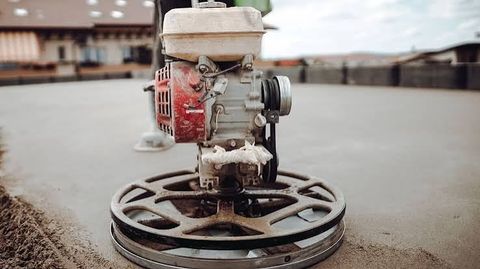
Concrete power trowel equipment uses rotating blades or pans to work the surface. Walk-behind models are generally used for smaller areas, while ride-on machines can cover larger slabs. Concrete polishing equipment and concrete grinding and finishing equipment are generally used after concrete has hardened.
| Equipment Type | Main Purpose | Typical Application |
|---|---|---|
| Concrete screeding equipment | Level and strike off fresh concrete | Slabs and floors |
| Power trowels | Smooth and finish concrete | Large floor areas |
| Grinders | Remove irregularities and prepare surfaces | Existing or cured concrete |
| Polishers | Refine and polish surfaces | Decorative and functional floors |
| Hand finishing tools | Detail edges and restricted areas | Small or difficult sections |
Industrial concrete finishing equipment is commonly used on warehouses, factories, infrastructure projects, commercial buildings, and large floor slabs. Commercial concrete finishing equipment may also be used in retail buildings, parking structures, institutional facilities, and other spaces where surface characteristics matter.
How the Finishing Sequence Works
A typical process begins with placement and initial leveling. Screeding establishes the general elevation of the slab, followed by floating or similar operations that help close and refine the surface.
Troweling may then be used to create a smoother and denser surface. Once the concrete has hardened sufficiently, grinding and polishing can refine the surface further. The exact sequence depends on concrete properties, environmental conditions, the required finish, and project specifications.
Importance
Concrete surfaces are used in many places that people encounter every day, including roads, warehouses, factories, parking areas, offices, stores, schools, and public buildings. The condition of these surfaces can affect how spaces are used, maintained, and accessed.
Concrete floor finishing machines help manage large areas more systematically than manual tools alone. Equipment selection also influences how evenly a surface can be worked and how efficiently different finishing stages can be coordinated.
Supporting Surface Quality
Concrete surface finishing equipment can help create surfaces with specific characteristics, such as a smooth texture, controlled flatness, or polished appearance. The required result varies according to whether the concrete will support vehicles, machinery, pedestrian traffic, storage systems, or decorative applications.
Industrial concrete floor equipment is particularly relevant where floors must accommodate repeated movement or equipment. In such environments, the finishing process needs to be compatible with the intended use of the slab.
Handling Large Floor Areas
Large concrete slabs can require coordinated equipment and careful timing because concrete changes as it sets. High capacity concrete finishing equipment is designed for applications where substantial areas need to be processed during the appropriate finishing window.
Complete concrete finishing equipment systems may combine screeds, power trowels, grinders, polishers, dust-control equipment, and supporting tools. Using several equipment types allows different stages of the finishing sequence to be handled according to their specific requirements.
Reducing Manual Repetition
Finishing concrete manually can involve repeated movements across large areas. Mechanical equipment can take over some of these repetitive activities while operators control the process and respond to changing surface conditions.
This does not eliminate the need for skilled oversight. Concrete behavior can vary with temperature, moisture, mix composition, slab thickness, and other conditions, so equipment operation still requires attention to the actual site environment.
Recent Updates
From 2024 through 2026, developments in concrete finishing have increasingly involved automation, sensor technology, remote control, and electrically powered equipment. Industry sources have described growing interest in laser-guided systems, automated trowels, remote-controlled grinders, and equipment designed for more controlled surface processing.
Automation and Laser Guidance
Automated concrete finishing systems are becoming more visible in large-scale floor construction. Laser-guided screeding systems can use elevation measurements to help control the height of freshly placed concrete, while newer robotic systems are being developed for leveling and finishing operations.
Research and product development have also explored autonomous power trowels that can detect floor boundaries and obstacles, create digital floor maps, and adjust movement based on sensor information. These developments indicate a gradual shift toward advanced concrete finishing machinery with greater levels of automated control.
Remote-Controlled Grinding and Polishing
Remote-controlled concrete grinding equipment has also continued to develop. Current equipment introductions include remotely operated grinders and dust-management systems intended for concrete surface preparation and polishing. These systems can separate some operator activities from direct machine handling.
High performance concrete polishing equipment is also being developed with greater attention to dust collection, tool configuration, and process control. These changes are relevant where surface preparation and indoor working conditions need to be managed together.
Electrification and Digital Controls
Battery-powered and electrically driven finishing equipment has received increasing attention, particularly for indoor environments where engine emissions and noise may be considerations. Some newer machines also incorporate electronic controls, sensors, remote operation, or automated movement functions.
These developments do not replace conventional equipment in every application. Instead, they expand the range of available approaches for projects with different floor sizes, surface requirements, and operating conditions.
Tools and Resources
Several resources can help people understand or plan concrete finishing work. Equipment manuals are useful for learning machine controls, operating limits, maintenance procedures, and appropriate applications.
Planning and Measurement Tools
Project teams may use floor measurement tools, moisture meters, straightedges, laser levels, and surface-profile measurements when evaluating concrete conditions. These tools help establish whether a surface is ready for a particular finishing stage.
Useful resources include:
- Concrete placement and finishing checklists for organizing work sequences.
- Floor measurement templates for recording surface conditions.
- Equipment manuals for understanding operating procedures.
- Concrete calculators for estimating material quantities.
- Laser-level references for understanding elevation and flatness measurements.
- Maintenance logs for tracking equipment inspection and component condition.
Surface Preparation Resources
Concrete grinding and finishing equipment often uses abrasive tooling with different grades. Coarser tooling can remove surface irregularities or coatings, while finer tooling can progressively refine the surface.
Precision concrete surface finishing systems may combine measurement, mechanical processing, and dust collection. Documentation from equipment manufacturers, construction training organizations, and technical standards bodies can provide additional information about concrete finishing methods and terminology.
Advanced concrete floor finishing systems may also incorporate digital controls or remote operation. These technologies are particularly relevant to large slabs where repeatable movement and systematic coverage are important.
FAQs
What is concrete finishing equipment used for?
Concrete finishing equipment is used to level, smooth, texture, grind, and polish concrete surfaces. Different machines are designed for specific stages, from fresh concrete screeding to hardened-floor polishing.
What are concrete finishing machines?
Concrete finishing machines are mechanical tools used to perform finishing tasks that may otherwise require extensive manual work. Examples include power trowels, screeds, grinders, and polishing machines.
How does concrete power trowel equipment work?
Concrete power trowel equipment uses rotating blades or pans to work the concrete surface. The operator controls movement and blade operation according to the condition of the concrete and the required finish.
What are concrete floor finishing machines used for?
Concrete floor finishing machines are used to prepare and refine floors in residential, commercial, industrial, and infrastructure environments. Their functions can include leveling, smoothing, grinding, and polishing.
What are automated concrete finishing systems?
Automated concrete finishing systems use sensors, electronic controls, guidance technologies, or robotic movement to perform selected finishing activities with reduced direct machine control. Their capabilities vary according to system design and project conditions.
Conclusion
Concrete finishing equipment covers a range of machines used to level, smooth, grind, and polish concrete surfaces. Concrete finishing machinery has developed from primarily manual and mechanical tools toward systems that incorporate laser guidance, electronic controls, remote operation, and automation. The appropriate equipment depends on the concrete condition, floor size, required surface characteristics, and finishing stage. Current developments show continued integration of mechanical equipment with digital measurement and automated control technologies.

Related Post...
Multi Nozzle Filling Systems: An Overview of Modern Filling Technology
Updated: September 24, 2026
Read More