Automatic Welding Machine: A Guide to Modern Welding Technology
An automatic welding machine is equipment designed to perform welding operations with limited manual movement of the welding tool.
Instead of requiring an operator to guide every part of the welding process, an automatic system can control movement, welding parameters, positioning, and other programmed actions. This approach has developed alongside advances in industrial manufacturing and robotics.
Traditional welding requires a person to control the torch or electrode while maintaining suitable movement, angle, heat, and timing. Automation introduced mechanical controls and programmable equipment that could repeat defined welding paths. Today, an automated welding machine can combine a welding power source, motion system, sensors, controllers, fixtures, and software.
How Automatic Welding Developed
Early automated systems were designed for repetitive manufacturing operations where the same joints had to be welded repeatedly. As electronic controls and industrial robots developed, automated welding became more adaptable to different part shapes and production requirements.
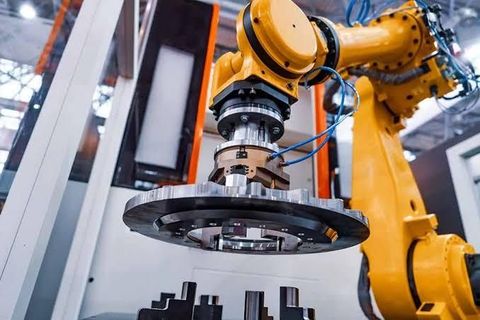
An automatic welding system may now use a programmable controller or robotic arm to position the welding torch. Sensors can also detect information about the workpiece or welding process. These technologies form part of broader automated industrial welding systems used in manufacturing environments.
Main Types of Automatic Welding Equipment
Different welding processes can be automated depending on the material, joint design, production requirements, and required control level. Common categories include:
- An automatic arc welding machine, which automates movement and arc welding parameters.
- An automatic MIG welding machine, commonly used for applications involving continuous wire electrodes.
- An automatic TIG welding machine, used where controlled arc welding and precise heat management are required.
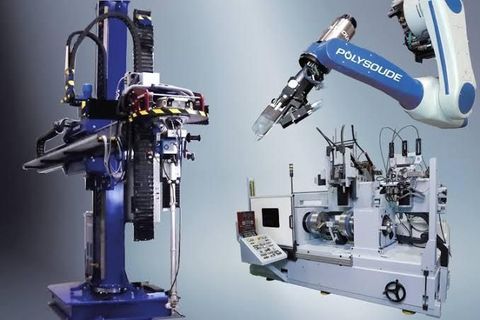
- A robotic welding machine, which uses a programmable robotic arm to move the welding tool.
- A precision automatic welding machine, designed for applications where controlled movement and repeatable positioning are important.
An industrial welding machine can be configured as an individual workstation or integrated into a larger production arrangement.
Importance
Automatic welding technology matters because welding is used in many products and structures, including vehicles, machinery, metal frames, storage equipment, and industrial components. Consistent welding can be important when many similar joints must be produced under controlled conditions.
An industrial automatic welding machine can repeat programmed movements across multiple workpieces. This can reduce variation caused by differences in manual movement, although the final result still depends on material preparation, welding parameters, equipment condition, and inspection.
Supporting Repetitive Manufacturing
Some manufacturing processes contain large numbers of similar welds. Repeating these activities manually can require considerable physical effort and close attention to torch position and travel speed.
An automated metal welding system can perform predefined movements repeatedly. This makes automation particularly relevant to production environments where parts have consistent geometry and fixtures can hold components in known positions.
Improving Process Control
Welding involves several variables, including current, voltage, travel speed, shielding gas, electrode or wire selection, joint preparation, and heat input. Automated equipment can control selected parameters according to a programmed welding procedure.
A robotic welding equipment setup can also coordinate torch movement with workpiece positioning. The degree of control varies between systems, so automation does not eliminate the need for appropriate process design or inspection.
Human Roles in Automated Welding
Automation changes how people interact with welding equipment rather than removing human involvement entirely. Operators and technicians may prepare components, configure equipment, monitor production, inspect welds, maintain systems, and adjust programs.
A complete robotic welding production line can contain several connected stages, such as material positioning, welding, inspection, handling, and data collection. Human oversight remains important when conditions change or when the process requires judgment.
Recent Updates
From 2024 through 2026, developments in welding automation have increasingly focused on robotics, collaborative robots, machine vision, digital monitoring, artificial intelligence, and coordinated multi-robot systems. These technologies are being developed to make automated welding more adaptable to variations in parts and production conditions.
Vision and Adaptive Welding
Modern robotic welding systems can incorporate cameras, laser sensors, and other sensing technologies. These tools can help identify joint locations, track weld paths, inspect completed welds, or compensate for certain variations in part positioning.
Recent industry discussions have also highlighted AI-assisted welding systems that can support programming, path planning, joint recognition, and adaptive control. These developments are intended to address one limitation of conventional robotic systems: their dependence on accurately defined paths and consistent part presentation.
Collaborative Welding Systems
Collaborative robots, commonly called cobots, are another area of development. These systems are designed for applications where robots and people may work in closer proximity under appropriate safety arrangements.
Cobot welding systems can be used for selected repetitive welding activities and may provide simpler programming interfaces than some traditional industrial robotic cells. Their suitability depends on factors such as welding process, workpiece size, production volume, workspace, and safety requirements.
Multi-Robot and Digital Systems
Another development is synchronized automation, where multiple robots coordinate movements within the same production cell. One robot may perform welding while another handles positioning, material movement, or another manufacturing task.
Digital monitoring is also becoming more closely connected with welding equipment. Systems can record welding parameters and inspection information, creating process records that can be reviewed for quality control and production analysis.
| Technology | Main Function | Typical Application |
|---|---|---|
| Automatic welding machine | Controls programmed welding movements | Repetitive welding |
| Robotic welding machine | Uses a robot for tool movement | Industrial production |
| Vision system | Detects position or weld features | Joint tracking and inspection |
| Cobot welding system | Supports selected collaborative tasks | Flexible welding cells |
| Multi-robot system | Coordinates several robotic operations | Integrated production |
| Digital monitoring | Records process information | Quality and process analysis |
These developments show a broader movement toward automated welding production systems that combine physical equipment with digital information.
Tools and Resources
Understanding an automatic welding machine requires knowledge of both welding principles and automation components. Several types of tools and resources can help explain how these systems operate.
Welding Planning Tools
Welding procedure documents can define parameters such as welding process, material, electrode or wire type, current range, voltage, travel speed, and shielding requirements. Welding calculators can assist with certain technical calculations, although their results need to be interpreted according to the relevant welding procedure and application.
Process diagrams and workflow templates can also help explain how an automated welding cell moves a component from loading through welding and inspection.
Automation and Programming Resources
Robot simulation software can be used to model robotic movements before equipment is operated in a physical environment. Programming interfaces allow users to define movement paths, welding parameters, sequences, and other operating instructions.
Technical manuals for welding power sources, robotic controllers, sensors, and safety equipment are also important resources. Standards and educational materials from welding and industrial automation organizations can provide additional background on welding processes and safe system design.
Equipment Selection Information
When examining automatic welding equipment price information, readers may encounter significant variation because systems differ in robot size, welding process, controls, sensors, fixtures, safety equipment, software, and integration requirements. A simple automated workstation and a complete robotic production line are therefore not directly comparable based on equipment price alone.
FAQs
What is an automatic welding machine?
An automatic welding machine is equipment that controls some or most welding movements and process parameters through programmed mechanical, electronic, or robotic systems. The exact level of automation varies between machine designs.
How does an automatic MIG welding machine work?
An automatic MIG welding machine uses a continuous wire electrode and shielding gas while automated equipment controls torch movement and selected welding parameters. The system may use a fixed mechanism, programmable motion system, or robotic arm.
What is an automatic TIG welding machine used for?
An automatic TIG welding machine is used for applications where controlled arc welding and accurate torch movement are important. TIG automation can be applied to suitable components in manufacturing and specialized fabrication environments.
What is the difference between an industrial automatic welding machine and a robotic welding machine?
An industrial automatic welding machine can use different forms of automated movement, while a robotic welding machine specifically uses a programmable robot to position and move the welding tool. A robotic system may also include sensors, fixtures, controllers, and inspection equipment.
What affects automatic welding equipment price?
Automatic welding equipment price depends on factors such as welding process, machine configuration, automation level, robot type, sensors, fixtures, control systems, safety equipment, and integration requirements. Prices can therefore vary substantially between different system configurations.
Conclusion
An automatic welding machine combines welding technology with mechanical, electronic, or robotic control to perform defined welding operations. Modern systems range from automated arc equipment and dedicated welding machines to robotic cells and connected production systems. Recent developments include machine vision, collaborative robotics, AI-assisted programming, digital monitoring, and synchronized multi-robot operations. The appropriate system configuration depends on the welding process, materials, part geometry, production requirements, safety considerations, and level of automation required.

Related Post...
Piling Equipment: A Guide to Modern Foundation Construction Machines
Updated: September 28, 2026
Read More
High Speed Machinery: An Overview of Modern Industrial Equipment
Updated: September 30, 2026
Read More