How Home Air Filtration Works: A Complete Guide
Home air filtration is a method of removing or reducing airborne particles from indoor air using filters and air-moving equipment.
Dust, pollen, pet particles, smoke particles, and other contaminants can circulate indoors, while an appropriate filtration system can capture some of these particles as air passes through a filter.
Home air filtration can be provided through central HVAC systems, portable air cleaners, return-air filtration systems, or whole-house arrangements. The appropriate setup depends on the home's ventilation system, filter requirements, room size, airflow, and the types of airborne particles that need to be addressed.
Why Home Air Filtration Matters
Indoor air can contain particles originating from outdoor air, household activities, furnishings, cooking, pets, and normal dust accumulation. Air filtration helps reduce the concentration of certain airborne particles by capturing them as air passes through a filter.
Common objectives of home air filtration include:
- Reducing airborne dust
- Capturing pollen particles
- Reducing pet-related particles
- Capturing certain smoke particles
- Supporting indoor air cleanliness
- Reducing airborne particulate matter
- Improving air circulation through filtration systems
Filtration is only one part of indoor air quality management. Ventilation, humidity control, source control, and regular cleaning can also affect indoor conditions.
How Home Air Filtration Works
Most filtration systems follow a relatively simple air-cleaning cycle.
1. Indoor Air Enters the System
Air is drawn into a filtration system by a fan. In a central HVAC system, air may enter through return-air ducts before passing through the furnace or air-handling equipment.
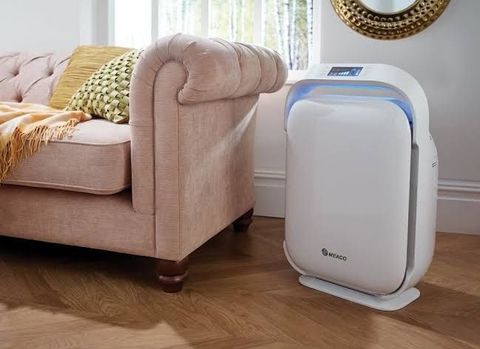
Portable air cleaners draw room air directly into the unit.
2. Air Passes Through the Filter
The incoming air moves through a filter containing a fibrous or other filtering material.
Particles can be captured through mechanisms such as interception, impaction, and, depending on the filter, diffusion. Larger particles may be captured more readily than very small particles, although filter design and airflow conditions also affect performance.
3. Particles Are Retained
As air passes through the filter, captured particles remain within the filter material.
Over time, particles accumulate on the filter. This is why filters require periodic inspection and replacement or cleaning according to their design.
4. Filtered Air Returns to the Room
After passing through the filter, the treated air is returned to the home through supply vents or discharged directly into the room from a portable unit.
The process then repeats as the fan continues circulating air.
Main Types of Home Air Filtration
Different filtration technologies are designed for different indoor air applications.
Mechanical Air Filters
Mechanical filters use fibers or other physical structures to capture airborne particles.
They are widely used in HVAC systems and portable air-cleaning equipment.
HEPA Filters
High-efficiency particulate air, or HEPA, filters are designed to capture a high proportion of very small airborne particles under specified test conditions.
Portable units containing HEPA filters can be used for room-level air cleaning. Some HVAC systems can also accommodate high-efficiency filters when the equipment is designed to handle the associated airflow resistance.
Pleated Filters
Pleated filters have folded filter media that provides more surface area within a compact frame.
They are commonly used in residential HVAC systems and are available in different filtration ratings and configurations.
Electrostatic Filters
Electrostatic filters use electrically charged media or electrical fields to improve particle capture. Some designs are washable or reusable, while others use replaceable filter media.
Activated Carbon Filters
Activated carbon is used to adsorb certain gases and odors rather than primarily capturing particles. Carbon filtration is often combined with mechanical filtration in residential air-cleaning equipment.
Washable Filters
Washable filters can be cleaned and reused according to the manufacturer's instructions. Their filtration characteristics vary by design and application.
Comparison of Home Air Filtration Types
| Filter Type | Main Function | Typical Application | Maintenance |
|---|---|---|---|
| Mechanical | Particle capture | HVAC and portable units | Replace or clean as specified |
| HEPA | High-efficiency particle capture | Portable and selected HVAC systems | Usually replaced |
| Pleated | Particle filtration | Residential HVAC | Periodic replacement |
| Electrostatic | Particle capture using electrical effects | HVAC and air cleaners | Clean or replace depending on design |
| Activated carbon | Adsorption of certain gases and odors | Air cleaners and combination filters | Replace media as required |
| Washable | Reusable particle filtration | Selected HVAC systems | Periodic cleaning |
Main Components of a Home Air Filtration System
Filter
The filter is the primary component responsible for capturing particles or adsorbing certain pollutants, depending on the filtration technology.
Fan
A fan moves air through the filtration system. Fan capacity affects airflow and the volume of air that can pass through the filter.
Filter Housing
The housing holds the filter in its correct position and helps prevent air from bypassing the filtering material.
Ductwork
Central HVAC filtration systems use ductwork to transport air between rooms and the air-handling equipment.
Airflow Controls
Some systems include controls that adjust fan operation according to temperature, air-quality measurements, schedules, or other operating conditions.
Sensors
Advanced air-cleaning systems can use particle, pressure, humidity, or other sensors to monitor indoor conditions and system operation.
Factors Affecting Filtration Performance
Several factors determine how effectively a home air filtration system operates.
Filter Efficiency
Filters differ in their ability to capture particles of different sizes. Higher filtration efficiency can provide greater particle removal but may also create greater resistance to airflow.
Airflow
A filter cannot clean air that does not pass through it. Fan operation and airflow therefore have an important effect on the amount of air processed.
Filter Size
The physical dimensions and surface area of the filter affect airflow resistance and filter loading.
Filter Loading
As captured particles accumulate, airflow resistance can increase. A heavily loaded filter can affect HVAC airflow and system operation.
Air Leakage
Air that bypasses the filter does not receive the same filtration treatment. Proper filter fit and housing design can reduce bypass.
Room Size
Portable air-cleaning units need to move an appropriate amount of air for the room in which they are operating.
HVAC and Whole-House Air Filtration
Central HVAC systems can provide filtration throughout a home because air is circulated through a network of return and supply ducts.
A whole-house arrangement can use a filter installed near the return-air side of the HVAC equipment. The system should be compatible with the selected filter because filters with greater airflow resistance may affect blower performance.
Portable air cleaners, by comparison, treat air within individual rooms rather than the entire house through a central duct system.
Automation and Air Quality Monitoring
Some modern residential air filtration systems include sensors and automatic controls.
These systems may monitor:
- Particle concentration
- Filter condition
- Airflow
- Fan speed
- Temperature
- Humidity
- Operating time
Based on sensor readings, some systems can automatically adjust fan operation or notify users when filter maintenance is required.
Applications of Home Air Filtration
Home air filtration can be used in different residential environments.
Bedrooms
Portable filtration units can circulate and filter air in bedrooms while occupants are present, depending on the unit's operating characteristics.
Living Areas
Larger rooms may use portable filtration units with airflow capacity appropriate for the room size.
Central HVAC Systems
HVAC filters can provide filtration as conditioned air circulates throughout connected spaces.
Homes With Pets
Mechanical filtration can capture various airborne particles associated with normal pet activity.
Homes in High-Particle Environments
Filtration can help reduce indoor particulate levels when outdoor air contains elevated amounts of dust, smoke, or other particles.
Maintenance Requirements
Regular filter maintenance is essential because filters accumulate captured material over time.
Maintenance frequency depends on filter type, indoor particle levels, household conditions, operating hours, and manufacturer instructions.
Homeowners should inspect filters periodically and replace or clean them according to the equipment requirements. Filter housings, return grilles, portable unit air inlets, and surrounding areas should also be kept clear of excessive dust.
Safety Considerations
Air filtration equipment should be operated according to the manufacturer's instructions. Filters should be installed in the correct orientation and size to prevent airflow problems or bypass.
High-efficiency filters should only be used in HVAC systems designed to accommodate their airflow resistance. An unsuitable filter can increase pressure drop and affect system performance.
Electrical components, fans, and filter housings should be inspected according to manufacturer guidance. Portable air cleaners should also have adequate clearance around their air intake and outlet.
FAQs
What is home air filtration?
Home air filtration is the process of passing indoor air through a filter to capture airborne particles or, in some systems, reduce certain gases and odors.
What types of filters are used in homes?
Common options include mechanical, pleated, HEPA, electrostatic, activated carbon, and washable filters. Each has different characteristics and applications.
How often should a home air filter be changed?
The interval depends on filter type, household conditions, operating hours, and manufacturer recommendations. Filters should be inspected regularly for loading and condition.
Can home air filtration remove all indoor pollutants?
No. Different filtration technologies target different pollutants. Particle filters primarily address airborne particles, while activated carbon can address certain gases and odors. Ventilation and source control also contribute to indoor air quality.
Can a high-efficiency filter be installed in any HVAC system?
Not necessarily. A high-efficiency filter can create greater airflow resistance, so the HVAC system should be designed to accommodate the selected filter's pressure drop.
Conclusion
Home air filtration works by circulating indoor air through a filter that captures airborne particles or, in some systems, adsorbs certain gases and odors. Mechanical, HEPA, pleated, electrostatic, activated carbon, and washable filters provide different approaches to residential air filtration.
Filtration performance depends on filter characteristics, airflow, filter size, loading, air leakage, and the design of the surrounding HVAC or portable system. Regular inspection and appropriate filter replacement or cleaning help maintain effective operation.
For residential indoor air quality, filtration works alongside ventilation, humidity management, source control, and routine cleaning. Selecting a compatible filter and maintaining the equipment according to manufacturer instructions are important parts of a properly functioning system.

Related Post...
Industrial Spinning Machines: Key Features for Reliable Yarn Production
Updated: September 21, 2026
Read More